
Conference: Engaging with Intersectionality in Population Research
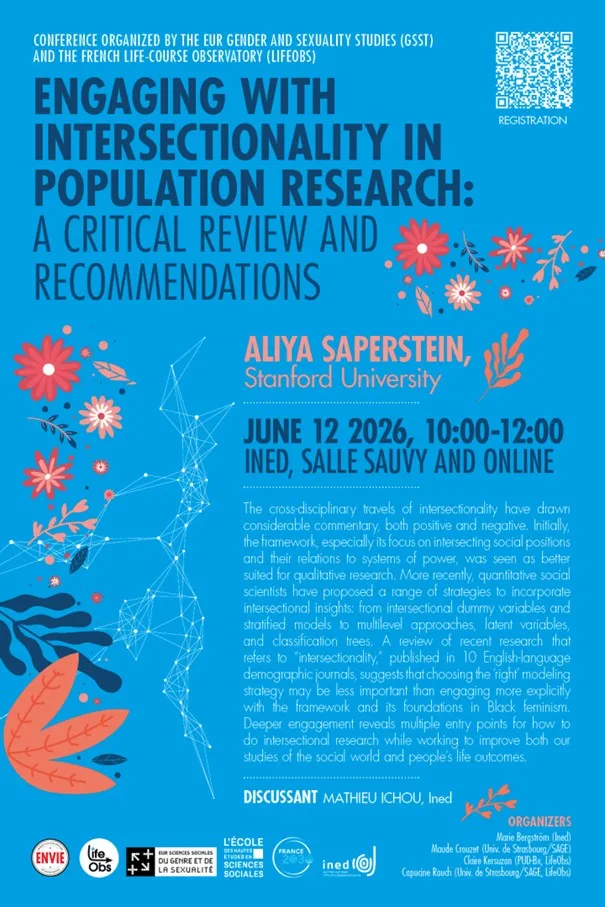
Engaging with Intersectionality in Population Research: A Critical Review and Recommendations
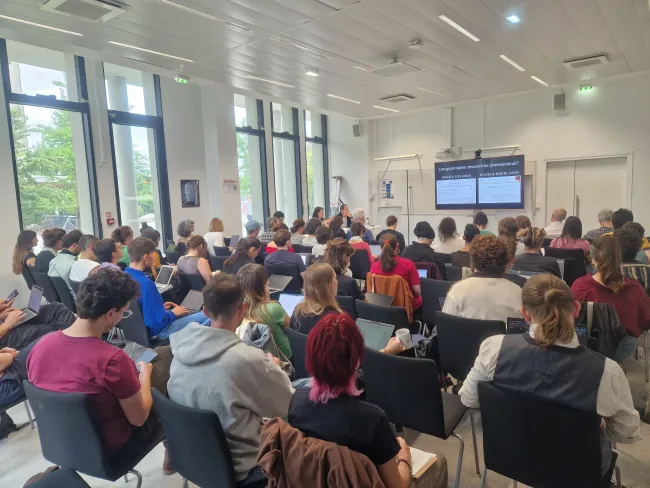
As part of the ‘Quantification, Gender and Sexuality’ summer school in statistics, the EUR Gender and Sexuality Studies (GSST) and LifeObs organised a conference on 12 June 2026 on the theme of intersectionality, with American sociologist Aliya Saperstein from Stanford University.
Nearly 90 participants attended the event, either in person or remotely.


The cross-disciplinary travels of intersectionality have drawn considerable commentary, both positive and negative. Initially, the framework, especially its focus on intersecting social positions and their relations to systems of power, was seen as better suited for qualitative research. More recently, quantitative social scientists have proposed a range of strategies to incorporate intersectional insights: from intersectional dummy variables and stratified models to multilevel approaches, latent variables, and classification trees. A review of recent research that refers to “intersectionality,” published in 10 English-language demographic journals, suggests that choosing the ‘right’ modeling strategy may be less important than engaging more explicitly with the framework and its foundations in Black feminism. Deeper engagement reveals multiple entry points for how to do intersectional research while working to improve both our studies of the social world and people’s life outcomes.
Marie Bergström (Ined), Maude Crouzet (Univ. de Strasbourg/SAGE), Claire Kersuzan (PUD-Bx, LifeObs) et Capucine Rauch (Univ. de Strasbourg/SAGE, LifeObs)